
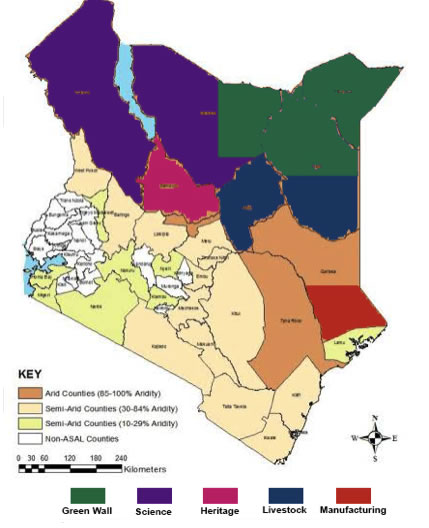
“With a population of over 53 million in Kenya, 36% of people live in Arid and Semi-Arid Lands (ASAL), which make up 89% of the country, while arid counties alone cover 70% of Kenya. Among the population living in ASAL, 3 million people depend on groundwater for domestic, livestock, and irrigation purposes. However, frequent and prolonged droughts exacerbated by climate change have made survival difficult for these communities.” In the recent drought emergency, the worse since 1981, ”between 80% and 90% of reservoirs and dams are drying up.
 Further, “conflicts and violence among the pastoralist communities…take different forms, including cattle rustling, clan and ethnic violence, and the displacement of people. The proliferation of Small Arms and Light Weapons (SALWs), climate change, land and water scarcity, the collapse of inter-communal social contracts, and bad politics have exacerbated this already tenuous situation. In addition, “human activities contribute to increasing desertification include the expansion and intensive use of agricultural lands, poor irrigation practices, deforestation, and overgrazing. These unsustainable land uses place enormous pressure on the land by altering its soil chemistry and hydrology, leading to increasing desertification in Northern Kenya.”
Given the global trends, it is likely that these drought and climatic change conditions will not only continue but intensify. Even high quality livelihood efforts will ultimately fail if there are not more planned, significant and even transformative efforts put into solving the challenge of the northern arid regions of Kenya. In the near future, especially the eight counties of Turkana, Samburu, Marsabit, Isiolo, Mandera, Wajir, Garissa and Tana River, will become more and more inhabitable with some think tanks even mentioning the long term possibility for structural resettlement of portions of the population.
There have been increased cases of insecurity which manifests itself in form of communal cross county conflicts caused by fighting over resources such as land, water and grazing land. The emergence of the Al-Shabaab insurgency has complicated the insecurity situation in the county leading to over stretching the existing security resources and personnel. The population living under absolute poverty is estimated to be 84 per cent. This implies that the majority of the population is unable to afford their minimum basic needs such as food, clothing and shelter. Majority are heavily dependent on relief food from the government and other organizations. The high incidence of poverty can be attributed to; unreliable rainfall, high levels of illiteracy, poor crop and animal husbandry practices, poor infrastructure, inaccessibility to credit facilities, poor marketing systems, natural disasters like frequent droughts, floods, livestock and crop diseases, wildlife menace and environmental degradation.
Arid Counties in Kenya enjoy the 4G network, is connected to electricity and those along the Ewaso Nyiro river have underlying acquifer. These factors present an opportunity to establish an innovation hub and a resilience facility centre to entrench regenerative society model in agriculture, livestock, agroforestry and enviro-wildlife conservation. Its envisaged this will help to accelerate entrepreneurship create wealth and jobs. Among the key initiatives is the setting up of a demonstration farm which seeks to help solve the issues of, food insecurity, and nutrition deficiency in the region, and act as an epicenter for peace building amongst the warring across the Horn of Africa.